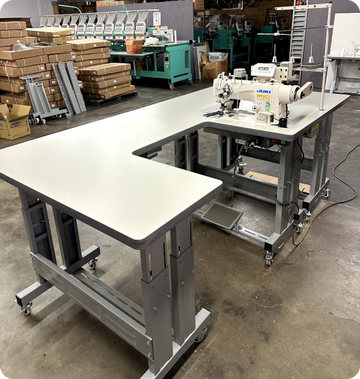

The fashion program at California State University, Fullerton (CSUF) had been running its sewing studio on clutch motors and worn workstations for over a decade. Prizzi offered a workstation support program at no cost to the program: new servo motors on every machine, new tables, matched stands. The sewing heads stayed. Everything around them changed. This is how it worked, and what the support program looks like for university fashion, textile, and industrial arts programs that want to upgrade.
How it started
Prizzi's relationship with the CSUF fashion program began with a single industrial lockstitch machine. The program needed reliable equipment for its studio, and we delivered it personally. That visit mattered: we walked the floor, looked at the equipment, talked with the program director. Over the following months the program added a few more machines from our catalog - overlocks and a buttonholer among them. Standard commercial purchases, nothing unusual.
What was unusual was the pattern each delivery revealed. The sewing heads worked fine. Everything around them did not. That is where the support program came in.
What we found
The CSUF studio ran on clutch motors. Every machine had one, some of them 10 to 20 years old. Three problems came with that.
First, noise. Clutch motors run at full speed constantly; the motor spins whether the operator presses the pedal or not. The studio director told us directly: when four students sew at the same time, the noise makes conversation impossible. In an educational setting, that's a teaching problem. Instructors can't give feedback. Students can't ask questions mid-operation. The noise floor turns a learning environment into an assembly line.
Second, the workstations themselves. Tables had cracked moldings. Colors didn't match. Some had chipped laminate, others had mismatched legs from previous repairs. The studio looked like a collection of leftovers from different decades, because it was.

Third, the motors were wasting energy. A clutch motor draws power continuously, regardless of whether the needle moves. For a production floor running eight hours, that adds up. For a university lab running three or four hours a day, the waste is proportionally worse: the motor spins through lectures, demonstrations, and pauses between exercises.

| Problem | What we observed |
|---|---|
| Noise | Four students sewing simultaneously made conversation impossible (confirmed by studio director) |
| Workstation condition | Cracked moldings, mismatched colors, chipped laminate across tables 10-20 years old |
| Motor efficiency | Clutch motors drawing constant power regardless of pedal input |
| Visual impression | Inconsistent, dated appearance across the studio |
What we offered
We proposed a workstation support program to the Cal State Fullerton fashion program at no cost to them. Same sewing heads. Everything else new. The program director confirmed the scope and we started planning the installation.
The core of the program was replacing every clutch motor with a Prizzi servo motor. Twelve workstations in total: nine 550W servos for the standard-weight machines and three 750W servos for the heavier heads. A servo motor spins only when the operator presses the pedal, stops instantly when they lift it, and draws power proportionally to the work being done. In practical terms: the studio goes quiet between stitches. An instructor can walk up to a student mid-operation and give feedback without shouting. Four machines running at once no longer fill the room with a constant mechanical drone.
We also replaced the tables and stands. Twelve new Prizzi sewing tables: ten standard flat tables and two submerged tables for the heads that needed a flush working surface. Clean moldings, consistent finish, proper machine cutouts for each head. Stands were matched to the machines already installed.

We delayed the installation intentionally. We wanted every servo motor in the CSUF lab to be a Prizzi unit rather than mixing third-party motors with our own. That meant waiting until we had enough stock. The wait added several months but gave the fashion program a uniform installation - and gave the support program a clean reference site for the universities that come next.

Before and after
| Before | After | |
|---|---|---|
| Motors | 12 clutch motors, constant-speed, always spinning | 12 Prizzi servos (9x 550W + 3x 750W), variable-speed, stops at needle-up |
| Noise during operation | Conversation impossible with 4 machines running | Typical of servo-driven workstations: quiet between stitches |
| Tables | Mismatched tables, cracked moldings, chipped laminate, 10-20 years old | 12 new Prizzi sewing tables (10 flat + 2 submerged), uniform finish |
| Stands | Mixed, some repaired | Matched to each sewing head |
| Sewing heads | Program's existing machines | Same heads, no changes |
| Energy draw | Constant (clutch motors draw power whether sewing or idle) | Proportional to use (servo draws only when pedal is pressed) |

Why this applies to your floor

Most sewing operations think about their equipment in terms of sewing heads. The head is where the stitch happens, so it gets the attention, the maintenance, and the budget. But the workstation around the head determines how efficiently, quietly, and comfortably that head gets used.
Clutch motors are still common. We see them on production floors that upgraded their sewing heads five years ago but kept the original motors because they still "worked." They do work, in the sense that they spin. But they spin constantly, waste energy during idle time, run louder than necessary, and give operators less control over stitch speed. A servo motor addresses all of this, and on most machines, swapping takes under an hour.
Tables wear out too, just slower. A cracked molding or chipped surface doesn't stop production, but it makes threading harder, snags fabric, and gradually makes the workstation worse without anyone noticing. We've walked production floors where the owner pointed at a row of new sewing heads sitting on 15-year-old tables with visible damage. The head is the investment. The table it sits on is quietly undermining it.
If your floor runs clutch motors and the tables look like they've been through a few too many production cycles, the upgrade path is straightforward. Motors and tables are the highest-impact, lowest-cost changes you can make to a sewing workstation. They don't require new training. They don't require downtime beyond the swap itself.
Ready to upgrade your workstations?
For production floors: Browse our servo motors and workstation accessories and sewing tables, or email roman@prizzisewing.com with the subject "Workstation Upgrade" for a walkthrough of what the swap looks like on your specific machines.
For universities and educational programs: If you run a fashion, textile, or industrial arts program and want to discuss what the workstation support program might look like for your lab, email roman@prizzisewing.com with the subject "University Support Program".
Products featured in this rebuild
- Prizzi servo motors - 550W and 750W variants, direct clutch-motor replacement
- Prizzi sewing tables - standard flat and submerged configurations
- Prizzi stands and legs - matched to the machine being installed
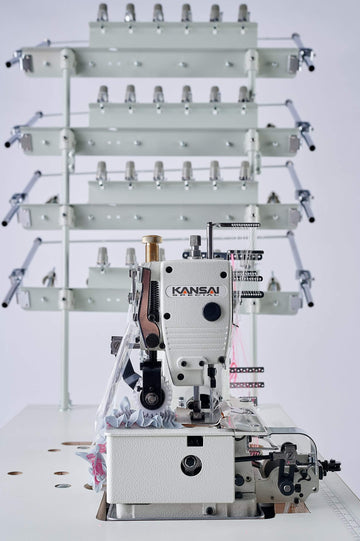
- Industrial sewing machines - Juki, Kansai Special, Pegasus, Brother and more
Frequently asked questions
Can I replace a clutch motor with a servo on any industrial sewing machine?
On most standard industrial machines, yes. A servo motor mounts in the same position as a clutch motor and uses the same belt drive to the sewing head. The swap takes 30-60 minutes per machine. Exceptions exist for some specialty heads with integrated motors or specific power requirements; check your machine's specs or contact us.
How much quieter is a servo motor compared to a clutch motor?
A clutch motor runs at constant speed regardless of whether the operator is sewing. That constant hum is what fills a room. A servo motor spins only when the pedal is pressed and stops completely at rest. The difference is immediately noticeable, especially in multi-machine environments. We don't publish dB comparisons because room acoustics vary, but every operator we've spoken to describes the change in the same terms: the room gets quiet between stitches.
Do I need to replace my sewing table if the machine still works?
The machine will run on any table that holds it. But a table with cracked moldings can snag fabric during feeding. Chipped surfaces make threading harder. Uneven legs introduce vibration. These are small problems individually, but they compound across an 8-hour shift. If your table is over 10 years old and showing visible wear, a new table improves the working experience and protects the machine.
Does Prizzi work with universities and educational programs?
We supply equipment to educational programs, small shops, and production floors on commercial terms. On top of that, Prizzi runs a workstation support program for university fashion, textile, and industrial arts programs - the Cal State Fullerton rebuild described above is one example. If you run such a program and want to discuss what might be possible for your lab, email roman@prizzisewing.com with the subject "University Support Program".

Co-Owner at Prizzi Sewing Machine Co.
Expert in sewing factory workflow optimization