

Your factory was built for 5,000-piece orders of the same style. Now you're getting 50 orders of 100 pieces each, every style different, every deadline shorter than the last. The production system that made you profitable in the mass production era is now the reason you're losing money. Here's why — and what the factories that adapted did differently.
The apparel industry has undergone a fundamental shift. Consumers want what they want, when they want it, in the quantity they want it. Social media accelerates trend cycles. E-commerce enables niche brands with small production runs. And the factories that can't respond flexibly to these demands are losing contracts to those that can.
This isn't a temporary trend. It's a structural change in how the industry operates. And it requires a structural change in how sewing factories produce.
What Mass Production Mode Actually Looks Like
The synchronized production system is the classic mass production model for sewing factories. Its characteristics:
- Single-skilled operators — each operator is dedicated to one process and specializes in that process alone
- Parts in lot production — collar parts, pockets, cuffs are produced in large batches to optimize each parts station independently
- Assembly in piece-by-piece flow — the assembly line processes one piece at a time, passing from station to station
- Focus on line balance and organization efficiency — because operators are dedicated, the primary lever for productivity is process distribution
This system works brilliantly when orders are large, styles are stable, and production runs last weeks or months. Operators become highly efficient at their single process. The line balance stays optimized because the product doesn't change. Changeover losses are rare because changeovers are rare.
Why It Breaks Down with Small Orders
When the same factory tries to run high-variety, small-lot production on a synchronized system, five problems emerge:
| Problem | What Happens | The Cost |
|---|---|---|
| Frequent changeovers | Every new style requires rethreading, re-tensioning, instruction distribution, and first-piece approval | 30-60 minutes lost per changeover. With 3-5 changeovers per day, you can lose 20-30% of productive time |
| Startup losses | Single-skilled operators need time to learn the new process for each style. Speed ramps up slowly. | First 20-50 pieces produced at 50-70% of full speed |
| Inflexible to absences | When a specialized operator is absent, nobody else can do their process. The line stops or produces with a gap. | One absence can reduce line output by 30-50% |
| Production management complexity | Data collection and process analysis take time. With short runs, the style is finished before the data is useful. | Managers fly blind — no time to identify and fix bottlenecks before moving to the next style |
| WIP explosion | Lot-based parts production creates inventory that doesn't match assembly needs. Parts for style A pile up while assembly is running style B. | Floor clutter, mismatched inventory, storage costs, quality issues from aging WIP |
Three Production Systems for the New Reality
Factories that have successfully transitioned away from mass production mode use one of three systems — or a hybrid. The right choice depends on your product mix, order sizes, and workforce capabilities.
1. Synchronized Production (Adapted)
Best for: Factories that still receive medium-to-large orders but need to handle more frequent style changes.
The core synchronized system remains, but with modifications:
- Operators cross-trained on 2-3 adjacent processes instead of one
- Standardized changeover procedures that reduce style switch time from 60 to 15 minutes
- Parts production synchronized with assembly demand instead of running independently in large batches
This is the lowest-disruption transition. It preserves the familiar line structure while adding the flexibility to handle more frequent changes.
2. Workstation-Based System (QRS)
Best for: Women's clothing factories, fashion-forward production, and factories with high style variety and short runs.
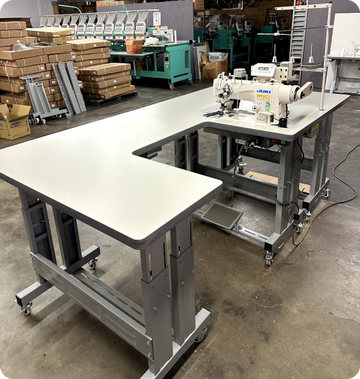
The Quick Response Sewing system organizes production around workstations rather than dedicated process stations. Each workstation integrates multiple pieces of equipment — a lockstitch machine, an ironing board, sometimes a specialized machine — so a single operator can perform multiple processes without moving.
Key characteristics:
- Multi-skilled operators who handle 3-5 processes at one station
- Piece-by-piece transfer between workstations, often using a hanger system that controls WIP
- Minimal changeover loss because the same workstation handles different styles by changing the process sequence, not the equipment
- Built-in ironing at each station, eliminating the separate pressing department bottleneck
The QRS system dramatically reduces startup losses and changeover time. The trade-off: operators must be multi-skilled, which requires significant training investment.
3. Standing Operation (Pull Production)
Best for: Sportswear, foundation garments, knitwear — products with varying complexity and order sizes from small to large.
In standing operation, equipment is arranged in a U-shape along the process order. Operators stand (rather than sit) and move between machines, each handling multiple processes. The system uses pull production — downstream operators "pull" work from upstream by going to the previous station and picking up the next piece when they're ready.
Key characteristics:
- Multi-skilled operators covering 3-8 processes each
- U-shaped layout minimizes walking distance between stations
- Overlapping work zones — each operator's responsibilities overlap with their neighbors, so they naturally support each other
- Near-zero WIP — because work is pulled piece by piece, there's almost no work-in-progress accumulating on the line
- Extremely high organization efficiency — the pull mechanism self-balances the line
The biggest advantage: a simple U-line producing underwear or t-shirts can be recombined into larger configurations for complex sportswear, giving the factory the flexibility to handle both small and large orders on the same floor.
Want an expert perspective? Prizzi's factory audit evaluates your current production system against your actual order profile and recommends the most practical transition path. This is part of our Stage 3: Optimization Plan. Learn more about Prizzi's Formula for Sewing Success →
The Multi-Skilled Worker Problem (And Solution)
Every modern production system requires multi-skilled operators. This is the single biggest barrier to transitioning away from mass production — and the most common reason factories postpone the change.
Here's how factories that successfully transitioned developed their multi-skilled workforce:
- Create a skills matrix. List every operator and every process. Rate each operator's proficiency at each process. This visual map shows exactly where the gaps are and where training should focus.
- Start with adjacent processes. Don't try to make every operator capable of everything. Train each operator on the one or two processes immediately before and after their current station. This creates overlap without overwhelming anyone.
- Use on-the-job training. Place experienced multi-skilled operators alternately with trainees on the line. The experienced operators handle their own work and support the trainees on adjacent processes. Production slows temporarily but real skills develop faster than classroom training allows.
- Create a proficiency ranking. When operators can see their multi-skill rating improving, it becomes a motivator. Tie proficiency levels to recognition — not necessarily pay, but visibility.
Production Management in the New System
High-variety, small-lot production creates a management challenge that didn't exist in mass production: by the time you've collected enough data to identify and fix a problem, the style has changed and the data is irrelevant.
The solution is real-time monitoring. IoT-enabled sewing machines can track operation rates, identify bottlenecks as they form, and generate pitch diagrams automatically — work that used to take hours of manual observation. An equipment operation management system collects data from every machine on the floor and visualizes it in dashboards that production managers can act on immediately.
Key capabilities to look for:
- Real-time productivity tracking — target vs. actual output by line, updated continuously
- Automatic bottleneck detection — the system identifies which station is limiting output right now, not last week
- Off-standard tracking — when problems interrupt production, operators log the cause, creating a Pareto chart of issues to address
- Equipment operation rates — machine-by-machine utilization shows which equipment is idle and why
The PDCA Framework for Continuous Improvement
Transitioning your production system is not a one-time event. It's the beginning of a continuous improvement cycle:
| Phase | Activity | Tools |
|---|---|---|
| Plan | Analyze current state: process analysis, time study, operation analysis. Set target daily production and target organization efficiency. | Stopwatch, process flow chart, skills matrix |
| Do | Design production: create process distribution, design layout, assign operators to processes. | Process organization chart, layout diagram |
| Check | Monitor results: identify bottlenecks, measure actual vs. target, find hidden problems. | IoT monitoring, spaghetti diagram, pitch diagram |
| Act | Improve: fix bottlenecks, reduce allowance, review production system fit. | Process redistribution, layout adjustment, equipment review |
Each cycle should produce better data and higher targets than the last. The goal is not perfection — it's a factory that never stops improving, regardless of how the market changes around it.
Is your production system keeping up with your order profile? Prizzi's factory audit team has helped sewing factories transition from mass production to flexible systems for 45+ years. Our three-stage assessment identifies whether your current system matches your market, develops a practical transition plan, and supports implementation — from multi-skilled worker development to layout redesign. Start with Prizzi's Formula for Sewing Success → or email roman@prizzisewing.com with the subject "Factory Audit."
Frequently Asked Questions
How do I know if my production system is wrong for my current orders?
Three signals: changeover time consuming more than 15% of your productive day, operator absenteeism causing disproportionate output drops (more than the absent operator's share), and work-in-progress levels growing despite stable or declining order volumes. If your order sizes have shrunk by more than 50% compared to five years ago but your production system hasn't changed, you're almost certainly losing efficiency to the mismatch.
How long does it take to transition from mass production to a flexible system?
The physical transition (layout change, workstation setup) can happen in days. The capability transition (multi-skilled workers) takes 3-6 months of structured training. Most factories run a hybrid during the transition — one or two lines converted to the new system while the rest continue on the old system. This limits risk and provides a comparison baseline.
Do I need to invest in new equipment to change production systems?
Usually not. Most transitions reuse existing equipment in a new arrangement. The QRS system may require adding vacuum ironing boards to sewing workstations, and standing operation may need U-shaped table arrangements. But the sewing machines themselves are typically the same. The investment is primarily in training, not equipment.
Can a factory run both mass production and small-lot systems simultaneously?
Yes — and many do. Large-volume orders can still run on synchronized lines where single-skilled operators maximize speed. Small-lot, high-variety orders run on flexible lines with multi-skilled workers. The key is separating the two physically and managerially. Don't try to make one line flex between both modes — the changeover overhead negates the benefit.
What's the biggest risk in transitioning production systems?
Productivity dip during the learning curve. Multi-skilled workers are initially slower than single-skilled specialists at each individual process. Output typically drops 10-20% during the first month of transition before recovering and eventually exceeding the old system's output. Plan for this by transitioning during a lower-volume period and maintaining buffer inventory to meet delivery commitments during the adjustment phase.

Co-Owner at Prizzi Sewing Machine Co.
Expert in sewing factory workflow optimization