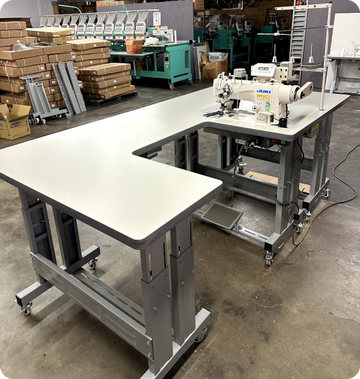
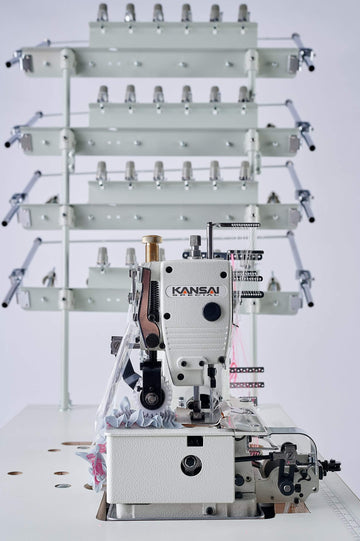


In manufacturing, growth usually comes with a familiar headache. More orders mean more pressure, more overtime, and the looming question of whether you need to hire more people or expand your facility. For many businesses, that traditional path simply isn't realistic. Labor is hard to find, training takes time, and expanding floor space can take years.
But one manufacturer proved that there's another way.
By rethinking how work gets done on the production floor—and investing in the right technology—they managed to double production without adding a single new employee. The secret wasn't longer hours or cutting corners. It was automation done right, powered by the JUKI AMS-210EN.
The Real Problem Wasn't People - It Was the Process
The company specialized in products that require strong, consistent stitching: reinforced seams, layered materials, and repeated patterns that must be sewn exactly the same way every time. Their team was skilled and experienced, but they were stuck with a process that relied heavily on manual work for tasks that were highly repetitive.
That created three major issues:
Inconsistent cycle times depending on operator fatigue and skill level
Production bottlenecks around complex stitch patterns
Limited scalability, even when demand surged
Adding more workers would have meant more training, more supervision, and more variability. Instead, the leadership team asked a better question:
What if the machine did the hard, repetitive thinking—so people could focus on flow, quality, and output?
Enter the JUKI AMS-210EN
The AMS-210EN isn't just a sewing machine. It's a programmable pattern sewing system designed to take complex, high-stress sewing operations and execute them with absolute consistency—every single time.
Once installed, it immediately changed the rhythm of the production floor.
Operators no longer had to manually guide intricate stitch patterns. Instead, they loaded a program, positioned the material, and let the machine do what it does best: move fast, stay precise, and never lose focus.
Why This Machine Makes Such a Big Difference
Speed That Actually Matters
The AMS-210EN reaches full sewing speed almost instantly. There's no slow ramp-up, no wasted motion. Each cycle starts fast and finishes clean, which dramatically reduces the time spent per piece. Over hundreds or thousands of units, those saved seconds turn into hours—and then into days of extra capacity.
Consistency You Can Count On
Human skill varies. Machines don't. Every stitch pattern produced by the AMS-210EN is identical to the last. That means stronger seams, fewer defects, and less time spent inspecting or reworking finished products.
Built for Heavy, Demanding Materials
This machine was designed with tough jobs in mind. Thick layers, dense webbing, reinforced corners—materials that slow down traditional machines are handled smoothly and confidently. The result is a stable stitch, even at high speed, without material slippage or distortion.
Programmable Flexibility
One of the biggest advantages is how easy it is to switch between products. Patterns are stored digitally and can be recalled in seconds. That means faster changeovers, smaller batch runs, and the freedom to respond quickly to new orders or design changes.
Energy and Cost Efficiency
Despite its performance, the AMS-210EN is surprisingly efficient. Its direct-drive system minimizes wasted energy, helping reduce operating costs over time. For manufacturers watching margins closely, this adds up to meaningful savings.
The Results: Production Doubled—Without More Staff
The impact was immediate.
With just one AMS-210EN added to the line, output jumped dramatically. Tasks that once required careful manual control were completed faster and more reliably. As additional machines were introduced, overall cycle time dropped by more than half.
Most importantly:
No new hires were required
No extra floor space was needed
Quality improved instead of declining
The same workforce, using smarter tools, was suddenly capable of producing at a level that once seemed out of reach.
What This Case Study Really Teaches Us
This isn't just a story about one machine. It's a reminder that productivity problems are often process problems, not people problems.
When skilled workers are tied up doing repetitive, precision-heavy tasks, they become the bottleneck. Automation like the JUKI AMS-210EN doesn't replace human expertise—it amplifies it. Operators become supervisors of quality and flow instead of manual laborers fighting fatigue and inconsistency.
Read Also: Meet the Top 4 Sewing Machines You Need to Launch a Hoodie Line
Read Also: Modernizing Garment Production with Advanced Juki Sewing Machines
Final Thoughts
If your production line feels maxed out but hiring isn't an option, it may be time to rethink how the work is being done. Strategic automation can unlock capacity you didn't even realize you had.
Doubling production doesn't always require doubling your workforce. Sometimes, it just takes one smart investment and a willingness to modernize how things get made.