This $135 bolt-on servo motor ended the heat, the noise and the idling power draw of my old clutch motor — in a 20-minute swap
No electrician. No new table. No new machine head. It bolts onto the same mounts your clutch motor already uses and plugs into a single household socket.
★★★★★ 4.9/5 · 270 reviews

By 11 a.m. my workroom had been running a hairdryer's worth of noise for three hours straight — except it wasn't a hairdryer, it was the clutch motor under my table, spinning at full speed whether I was sewing or sitting there pinning a hem.
If you run a clutch motor, you know the routine. The clutch disc wears down and the machine starts slipping, so you replace it. The motor runs hot enough after a few hours of production that you learn not to rest a hand on it. And the whole time it's burning electricity with the pedal untouched — because a clutch motor spins from the second you flip the switch to the second you flip it off, sewing or not.
The speed control is its own special torture. Ease onto the pedal at the wrong spot and the needle dives at full punch — straight through a silk collar, into a leather panel, or onto the top of your own finger. Every sewer has a story about that needle. Beginners don't even get the luxury of the story; they just get to be terrified of the pedal.
So I finally did what I'd been putting off for two years: I stopped upgrading around the motor and replaced it. What follows is what I found out — about what the old motor was really costing me, and about the swap that fixed it in one afternoon.

The hidden cost of a clutch motor nobody puts on the invoice
Every shop with a clutch motor is paying four bills at once — only one of them shows up on the power company's statement.
Consumption figures per Prizzi's own measurements: a 550W servo averages roughly 150–350 W/h depending on operating mode; a 400W clutch motor consumes 400 W/h continuously.
What your clutch motor is actually doing to your shop
It sews nothing and burns power anyway
A clutch motor is always operating when the machine is on. Pinning, cutting, re-threading, marking — the motor spins through all of it at full draw. The servo only consumes power when the machine runs, and only in proportion to the load.
It runs hot and eats its own parts
Prolonged operation pushes clutch motors to temperatures you can feel from a foot away — and the clutch disc is a wear part, on a replacement schedule, for the life of the machine. The servo has no clutch disc and requires no maintenance.
It punishes the low end of the pedal
Fine work lives at low speed, which is exactly where a clutch motor is hardest to modulate. The needle lands like a hammer — bent needles, needle-stuck fabric, ruined pieces. A servo's smooth start and proportional pedal take that gamble off the table.
Here's where I got stuck — and it's probably where you're stuck too
When I finally went looking for a fix, the market tried to sell me everything except the fix:
A new machine head. The obvious answer and the expensive one — many modern machines are direct-drive with the servo built in. But my head sews perfectly. Throwing away a good machine to escape a $135 problem never added up.
A third motor for the clutch. Rebuild kits, new discs, more adjustment shims — that's not a fix, that's a subscription to the old motor's worst habits, paid in parts and downtime.
Living with it. The default option. Louder shop, hotter motor, higher power bill, and a pedal that punishes anyone still learning their way around it.
What I actually needed was embarrassingly simple: keep the machine, keep the table, replace only the motor — with something that draws power only while I sew and holds its nerve at low speed.

Meet Prizzi: the servo that finally changed everything on my table
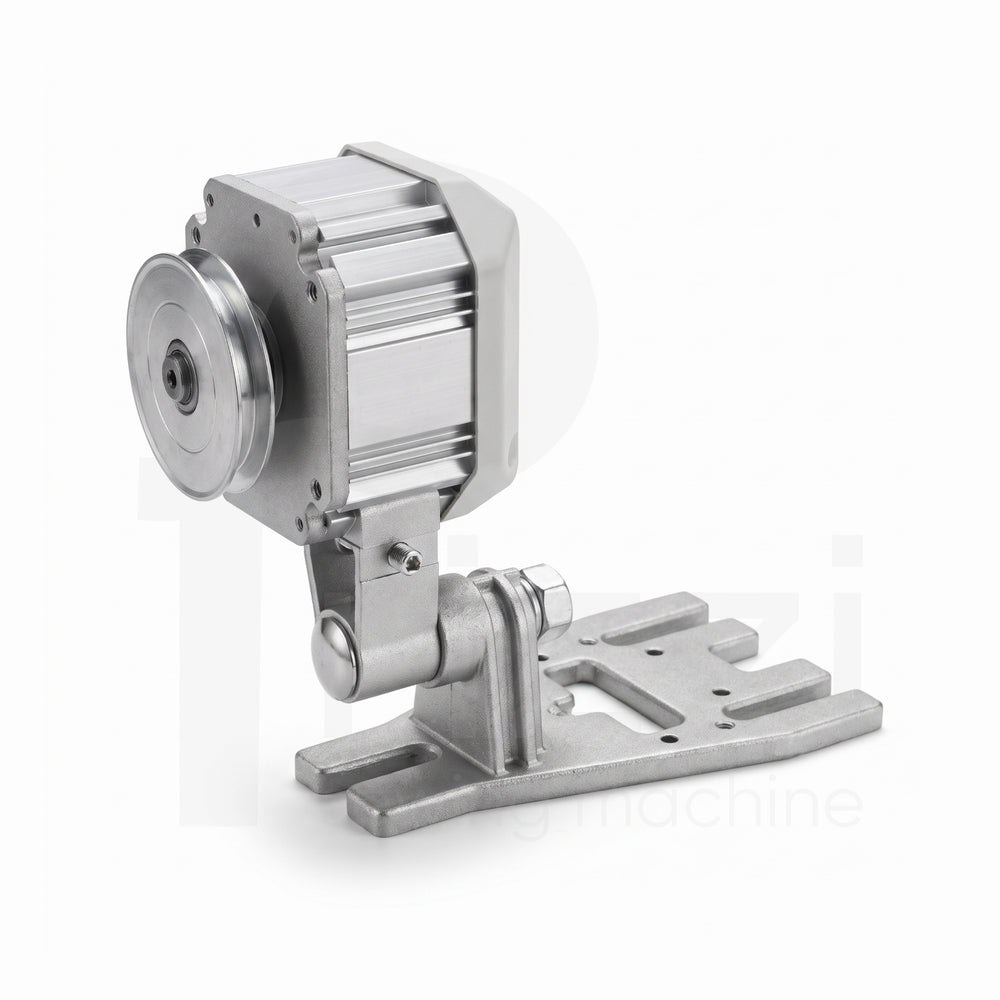
The Prizzi servo motor is a drop-in electric conversion for industrial sewing machines — and it behaves nothing like the motor it replaces:
- Power only when you sew. It consumes electricity only while the machine runs, in proportion to the load — nothing at rest between seams.
- Stronger starting torque. Electronic control gives the servo greater starting torque than a clutch motor — full authority right from the first stitch.
- A pedal that does what it's told. Press harder, motor speeds up; press softer, motor slows down. Stitch-by-stitch speed is exactly how beginners learn on it.
- Needle positioning (on positioner-equipped models). The motor rotates precisely to a programmed stop angle, so the needle automatically parks up or down.
- Quiet by design. 50–65 dB instead of the clutch motor's 65–80 dB — the difference between a shop and a conversation.
- Nothing to service. No clutch disc, no periodic maintenance — the wear-parts schedule simply disappears.
What changes when you swap the motor
-
First hour
The shop goes quiet in a way you can hear. Flip the machine on and nothing roars — the motor only speaks when your foot asks it to.
-
First day
The slow end of the pedal becomes usable. Feathering in one stitch at a time stops being a party trick and becomes the default.
-
First week
Fewer needle sticks and fewer ruined pieces — the smooth start quietly deletes the mistakes the clutch motor's punch used to cause. The motor stays cool through long runs.
-
First month
The power bill starts telling the story: the servo drew roughly 150–350 W/h while you worked, against the clutch motor's flat 400 W/h — and drew nothing while you didn't.
-
Every month after
Nothing. No clutch disc to replace, no periodic service, no downtime for the motor. That line item is gone from the books.
How the Prizzi servo compares to your old clutch motor
| Prizzi servo motor | Old clutch motor | |
|---|---|---|
| Power draw while idle | Standby draw comparable to an LED lamp — a fraction of the clutch motor's constant draw | Full 400 W draw the whole time it's switched on |
| Power while sewing | 150–350 W/h, proportional to the load | Flat 400 W/h regardless of what the fabric needs |
| Noise | 50–65 dB | 65–80 dB |
| Starting torque | Greater — electronic control | Lower at takeoff |
| Low-speed control | Smooth start, proportional pedal — one stitch at a time | Hard to modulate at the slow end — needle sticks, ruined fabric |
| Needle positioning | Auto stop at a programmed angle (positioner-equipped models) | Not available |
| Maintenance | None required | Periodic clutch disc replacement & servicing; runs hot in prolonged operation |
| Installation | Bolts to the same mounts; single-phase household power | — |
Run your own numbers
Energy savings depend on how long your machines stay switched on, what you pay per kWh, and how many stations you run. Set your numbers and watch what the old motor is costing you.
Estimates for one working year of 250 days. Based on Prizzi's stated consumption figures: a 400W clutch motor draws 400 W/h continuously while switched on, versus a 550W servo motor averaging 150–350 W/h depending on operating mode — the 250 W/h midpoint is used here. Savings scale linearly with machine count; the payback time per motor depends only on your hours and kWh price. Servo motor priced at the current Prizzi listing.
The math on paper
Dollars saved per machine per year — and how fast the $135 motor pays for itself from electricity savings alone. The kWh saved per machine are shown in each row: 300 kWh per year at 8 working hours a day.
| Machine on / day | $0.10 / kWh | $0.15 / kWh | $0.25 / kWh | $0.35 / kWh |
|---|---|---|---|---|
| 4 h — 150 kWh saved | 15 · ≈ 9 yr | 23 · ≈ 6 yr | 38 · ≈ 3.6 yr | 53 · ≈ 2.6 yr |
| 6 h — 225 kWh saved | 23 · ≈ 6 yr | 34 · ≈ 4 yr | 56 · ≈ 2.4 yr | 79 · ≈ 1.7 yr |
| 8 h — 300 kWh saved | 30 · ≈ 4.5 yr | 45 · ≈ 3 yr | 75 · ≈ 1.8 yr | 105 · ≈ 1.3 yr |
| 10 h — 375 kWh saved | 38 · ≈ 3.6 yr | 56 · ≈ 2.4 yr | 94 · ≈ 1.4 yr | 131 · ≈ 1 yr |
| 12 h — 450 kWh saved | 45 · ≈ 3 yr | 68 · ≈ 2 yr | 113 · ≈ 1.2 yr | 158 · ≈ 10 mo |
Per machine, rounded. Running more stations? Multiply every dollar figure by your count — the payback months stay the same. Based on Prizzi's stated consumption: a 400W clutch motor drawing 400 W/h continuously versus a 550W servo motor averaging 150–350 W/h (midpoint 250 W/h used). Servo motor priced at the current Prizzi listing.
The swap: under 20 minutes, three steps
Unbolt the clutch motor
The Prizzi servo uses mounts identical to standard clutch motor mounts — the old motor's bolt holes are the new motor's bolt holes.
Bolt on the servo
Same position, same belt line, same table. The controller mounts beside the head and connects to the motor.
Plug into the wall
Single phase, standard household power — the same socket your lamp uses. Press the pedal; the harder you press, the faster it goes.
What Prizzi customers say
★★★★★ 4.9/5 from 270 reviews
“The digital speed motor is excellent and I love the ability of being able to control my needle speed to work on delicate items.”
Michael GoreVerified Customer · Servo Motor“Great company, great communication. Everything arrived on time and in great shape.”
Doug LandersVerified Customer“Great machine and great distributor. Will definitely buy from Prizzi again.”
Michael BurkeVerified CustomerShop with confidence
Protected delivery: if your order arrives with evident damage, document it with photos and notify us within 3 days. After we verify the damage, we'll ship a replacement part at no charge.
Trusted by manufacturers since 1981. Questions before you order? Call (626) 350-4234 or email orders@prizzisewing.com.
Still unsure? What to know before the swap
Will it fit my machine and table?
Is it really easier for a beginner?
Can it really stop the needle exactly where I want it?
Does it hold up at low speed, or does it bog down?
How long until the energy savings pay for it?
What about specific models and specs — RPM, torque figures?
What maintenance does it need?
Your clutch motor is costing you while you read this
It's spinning right now, drawing its flat 400 W, wearing its clutch disc, filling your shop with 65–80 dB — whether anyone is sewing or not. The Prizzi servo ends all three for $135 and a 20-minute swap onto the mounts you already have.
Same mounts · Single-phase plug-in · No maintenance · Browse all servo motors
“The digital speed motor is excellent and I love the ability of being able to control my needle speed to work on delicate items.”
Shipping
Shipping available to all U.S. states. Order today for the fastest delivery.
Local pickup
Pickup available at 1818 Floradale Avenue, South El Monte, CA 91733. Usually ready in 2–4 days.
Why Prizzi
40+ years of trust, empowering top manufacturers since 1981. Exclusive KANSAI distributor. 100% new machines.
Servo Motors
Save 10% this Pre Black Friday
No sales tax (except CA, FL)
It bolts onto the same mounts your clutch motor already uses and plugs into a single household socket.
- Fits standard clutch mounts
- Single-phase household power
- 50–65 dB vs 65–80 dB
- No clutch disc, no maintenance
1Choose your Type
100% Guaranteed Safe & Secure Checkout