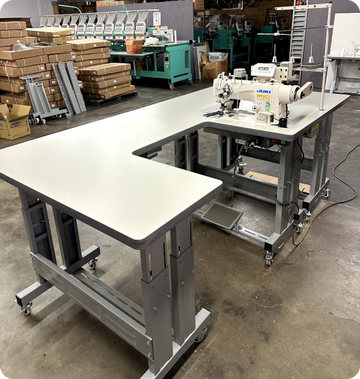
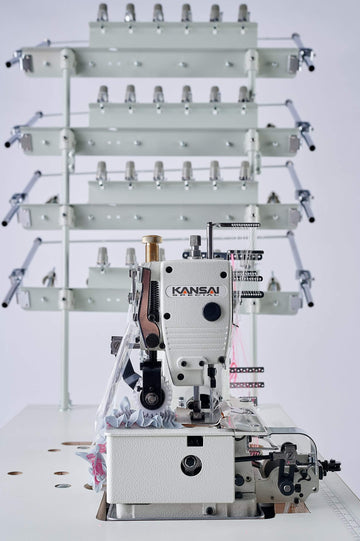


A factory owner calls us about buying ten new lockstitch machines. Output is too low, operators are backed up, and the solution seems obvious — more machines, more capacity. We ask one question: what's your organization efficiency? Silence. Nine times out of ten, the problem isn't equipment. It's how the existing equipment is being used.
New sewing machines are expensive. A single industrial lockstitch with auto-trimmer runs $2,000-$4,000. An automatic pocket setter can cost $15,000+. A full line upgrade for 20 stations could be a six-figure investment. And if the real problem is process design, layout, or line balance — every dollar spent on new equipment is wasted on machinery that will sit idle at a faster speed.
Here are five signs that your factory needs process optimization before it needs new machines.
Sign 1: Your Organization Efficiency Is Below 75%
Organization efficiency measures how evenly work is distributed across your operators. It's calculated by dividing the pitch time (average work allotment time per operator) by the bottleneck process time (the longest single operator's time), expressed as a percentage.
If your organization efficiency is below 75%, it means your operators are spending at least 25% of their time waiting — not because they're slow, but because the work isn't evenly distributed. Adding machines doesn't fix this. It gives idle operators even more capacity to sit unused.
What to do instead: Measure each operator's work allotment time. Identify the bottleneck process and redistribute work so all operators fall within the upper and lower control limits. This alone can improve output by 30-50% without any capital expenditure.
Sign 2: Work-in-Progress Is Piling Up at One or Two Stations
Walk your production floor. If you see bundles accumulating at specific stations while other operators wait for work, your line has a bottleneck — not a capacity problem.
New machines spread across the line won't help because the constraint is at a single point. Output is limited by the slowest process, and adding speed everywhere else just creates more expensive idle time.
What to do instead: Focus all improvement effort on the bottleneck station. Three methods — work redistribution, operational improvement, and targeted equipment upgrades — can break the bottleneck. If you do need to buy a machine, buy one machine for the bottleneck station, not ten machines for the whole line.
Sign 3: Operators Are Walking More Than Sewing
Does your floor look busy but your output numbers tell a different story? The culprit is often allowance — time spent on non-sewing activities like walking to pick up materials, carrying finished work to the next station, searching for supplies, or waiting for quality inspection.
In factories we audit, operators typically lose 20-40% of their shift to these interruptions. Faster machines don't reduce walking time. They just wait faster between trips.
What to do instead: Build a spaghetti diagram of your production floor to visualize movement patterns. Then redesign the layout so products flow forward through adjacent stations, material chutes replace manual carrying, and parts arrive at the operator's station instead of the other way around.
Want an expert perspective? Prizzi's factory audit measures your actual allowance rate and organization efficiency before recommending any equipment changes. This is part of our Stage 1: Product Model Assessment. Learn more about Prizzi's Formula for Sewing Success →
Sign 4: You're Running the Same Production System You Used 10 Years Ago
Has your order profile changed? More styles, smaller quantities, shorter lead times? But your production line still runs the same way it did when you had five large-volume contracts?
A synchronized production system — where each operator is a single-skilled worker dedicated to one process — works well for mass production. But when order sizes shrink and style changes increase, this system breaks down. Changeover losses pile up. Single-skilled operators can't cover for absent colleagues. And the rigidity of the line means you can't flex capacity between styles.
Buying new machines for a production system that doesn't match your order profile is like putting a new engine in a car that's driving the wrong direction.
What to do instead: Evaluate whether your production system matches your current order profile. Small-lot, high-variety production needs flexible systems — multi-skilled operators, U-shaped layouts, or workstation-based systems where one operator handles multiple processes. The transition takes training and planning, but the investment is in people and process, not machinery.
Sign 5: Your Machines Are Running But Your Output Is Flat
This is the most deceptive sign. Machine utilization looks healthy. The floor sounds busy. But daily output hasn't increased in months, even though nothing obvious has changed.
The hidden cause is usually a combination of factors: slight line imbalances that compound across shifts, gradual increases in rework rates that nobody tracks, changeover times that have crept up as styles became more complex, and maintenance issues that create intermittent micro-stoppages nobody counts.
What to do instead: Conduct a full production self-assessment. Measure organization efficiency, allowance rate, changeover time, and rework rate. Compare these numbers to your baseline from six or twelve months ago. The gap between machine utilization and actual output is where your improvement opportunity lives — and it's usually a process problem, not an equipment problem.
The Equipment Decision Framework
This doesn't mean you should never buy new machines. Equipment upgrades are the right call when:
| Buy New Equipment When... | Optimize Process Instead When... |
|---|---|
| Organization efficiency is already above 85% and you've exhausted process improvements | Organization efficiency is below 80% — there's output to recover without spending |
| The bottleneck is a single machine-limited process (the machine literally can't go faster) | The bottleneck is caused by uneven work distribution or operator motion waste |
| You're entering a new product category that requires equipment you don't own | You're trying to increase output on existing products with existing equipment |
| Your machines are beyond their maintenance life and repair costs exceed replacement costs | Your machines work fine but operators aren't using them at full capacity |
| A specific automation (auto-pocket, auto-buttonhole) eliminates a skill bottleneck | The process could be done faster with better training, attachments, or work sequence |
The Math That Proves It
Consider a 15-operator line producing jackets at 60% organization efficiency. The bottleneck process takes 85 seconds. The pitch time is 51 seconds. Daily output: approximately 340 pieces in an 8-hour shift.
Option A: Buy 5 new machines ($20,000). The machines are faster, but the bottleneck and process distribution stay the same. Output stays at roughly 340 pieces.
Option B: Spend $2,000 on process analysis, work redistribution, and two attachments for the bottleneck station. Organization efficiency rises to 85%. New bottleneck time: 60 seconds. Daily output: approximately 480 pieces — a 41% increase.
Option B costs one-tenth as much and delivers the output increase that Option A can't.
Before you approve that equipment purchase order, let Prizzi's factory audit team measure what your existing machines can actually deliver. Our 45+ year track record includes factories that doubled output without buying a single new machine — by optimizing process distribution, layout, and line balance. Start with Prizzi's Formula for Sewing Success → or email roman@prizzisewing.com with the subject "Factory Audit."
Frequently Asked Questions
How do I know if low output is a machine problem or a process problem?
Measure your organization efficiency. If it's below 80%, the problem is almost certainly process — uneven work distribution, bottlenecks, or layout waste. If organization efficiency is above 85% and individual machines are running at rated speed but output is still insufficient, then you may have a genuine capacity constraint that requires equipment.
What's the first thing I should measure before buying new equipment?
Organization efficiency. It takes 30 minutes: time each operator's work allotment, find the average (pitch time), find the maximum (bottleneck), and divide. If the result is below 80%, you have significant output to recover through process optimization alone. That recovery is essentially free — no capital expenditure required.
Can process optimization really replace the need for new machines?
In most cases, yes. A factory operating at 55% organization efficiency that improves to 85% through process redistribution and layout optimization will see output increases of 40-55%. That's equivalent to adding 6-8 operators on a 15-person line — or buying the machines to equip them. The difference is that process optimization costs a fraction and delivers results within weeks, not months.
When is an equipment upgrade actually the right decision?
When your process is already optimized (organization efficiency above 85%), your layout minimizes walking and material handling, and a specific process is still limited by the machine's physical speed. Also when entering new product categories that require equipment you don't have. The key is to optimize the process first so you know exactly which machine to buy and why — not to buy broadly hoping it helps.
How much does a factory process audit cost compared to new equipment?
A professional factory audit typically costs 5-15% of what a full equipment upgrade would cost, but often delivers equal or greater output improvement. More importantly, the audit tells you exactly where to invest if you do need equipment — so when you buy, you buy the right machine for the right station, not ten machines spread across a line that's still poorly balanced.

Co-Owner at Prizzi Sewing Machine Co.
Expert in sewing factory workflow optimization