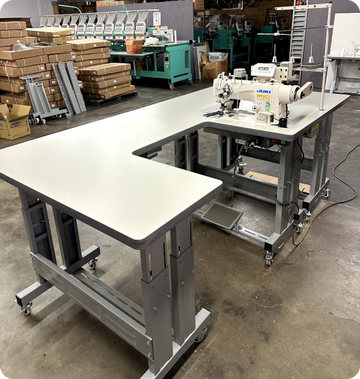
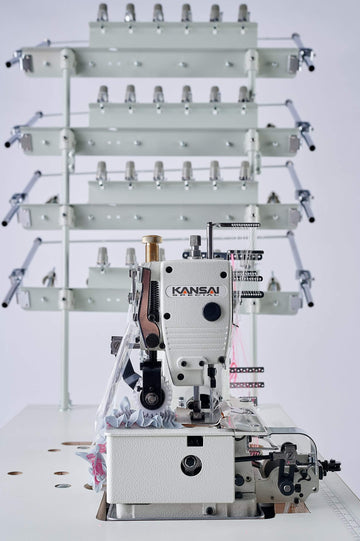


In modern apparel and textile manufacturing, speed alone is no longer enough. Today’s factories need precision, consistency, flexibility, and smart automation to stay competitive. That’s exactly where JUKI stands out. Known worldwide for engineering excellence, JUKI continues to push the boundaries of industrial sewing with computer-controlled machines that are built for real-world production demands.
If your goal is to reduce rework, improve stitch quality, and maximize output without overloading operators, upgrading to advanced JUKI automation can be a game-changer. Below, we explore how three powerful machines—the LK1910S(H)A5000Z/MC6762DD, LK1903BNSS302/MC672ENN, and LBH-1790ANS—help manufacturers boost efficiency while maintaining exceptional quality.
Precision That Works at Production Speed
One of the biggest challenges in high-volume manufacturing is maintaining uniform quality across thousands of garments. Manual adjustments and inconsistent stitching can slow production and lead to costly defects. JUKI’s computer-controlled technology solves this by automating critical sewing processes and delivering repeatable results—shift after shift.
These machines don’t just sew faster; they think smarter, helping operators work more confidently while reducing dependency on advanced manual skills.
JUKI LK1910S(H)A5000Z/MC6762DD
High-Speed Bartacking with Intelligent Control
Bartacking is a small detail that carries huge importance. Whether reinforcing belt loops, pocket corners, or stress points, bartacks must be strong, clean, and consistent. The LK1910S is designed specifically to excel in this area.
This machine delivers impressive speed while maintaining tight stitch accuracy, even on heavier materials. The direct-drive system minimizes vibration and mechanical loss, which results in smoother operation and better stitch formation. Operators benefit from a built-in voice guidance system that provides real-time feedback, making setup and operation faster and more intuitive.
Another major advantage is pattern flexibility. With a wide selection of pre-programmed bartack patterns, manufacturers can easily adapt to different garment styles without complicated mechanical changes. The result is shorter changeover times, fewer errors, and higher daily output.
Production benefit: Faster reinforcement stitching with consistent strength and appearance, ideal for jeans, workwear, uniforms, and bags.
JUKI LK1903BNSS302/MC672ENN
Reliable Button Sewing for High-Volume Output
Button attachment is often underestimated, yet it’s one of the most time-consuming finishing operations in garment production. The LK1903BNSS302 is built to remove inefficiencies from this process while delivering clean, professional results.
This button sewing machine operates at high speed while maintaining precise button positioning, thanks to its controlled feeding mechanism. Digital controls allow operators to quickly adjust sewing parameters, store patterns, and replicate settings across multiple machines—perfect for factories managing large production runs.
Its ability to handle a wide range of button sizes and sewing patterns makes it highly adaptable, whether you’re producing shirts, jackets, uniforms, or fashion garments. Consistent stitching reduces loose buttons and customer complaints, protecting both productivity and brand reputation.
Production benefit: Faster button attachment with reduced labor fatigue, lower defect rates, and smooth integration into automated lines.
JUKI LBH-1790ANS
High-Speed Buttonholes with Premium Finish
Buttonholes demand absolute precision. Any inconsistency is immediately visible to the end customer. The LBH-1790ANS is designed for manufacturers who need speed without compromise.
This machine uses advanced electronic control to manage feeding, stitching, trimming, and presser movements with exceptional accuracy. One of its standout features is intelligent thread tension control, which adjusts tension at different stages of the buttonhole. The result is a clean, balanced stitch that looks polished on both lightweight and heavier fabrics.
With its high sewing speed, this machine dramatically shortens cycle times while maintaining a refined appearance. It’s especially valuable for factories producing tailored garments, dress shirts, outerwear, and uniforms where buttonhole quality directly impacts perceived value.
Production benefit: High-volume buttonhole production with a premium finish that meets demanding quality standards.
Why Computer-Controlled Sewing Is a Smart Investment
Switching to advanced computer-controlled machines isn’t just about upgrading equipment—it’s about transforming your workflow.
Manufacturers who adopt JUKI automation benefit from:
Higher productivity through faster sewing speeds and reduced downtime
Consistent quality regardless of operator experience
Simplified training thanks to intuitive controls and guided operation
Reduced waste and rework, saving material and labor costs
Scalability, allowing factories to grow without sacrificing control
In an industry where margins are tight and expectations are high, these advantages add up quickly.
Read Also: From Web Vitals to Workshop Efficiency: What Industrial Distributors Need to Know
Read Also: Modernizing Garment Production with Advanced Juki Sewing Machines
Final Thoughts
Efficiency today means more than just working faster—it means working smarter. With advanced computer-controlled sewing machines like the LK1910S bartacker, LK1903 button sewing machine, and LBH-1790ANS buttonhole system, JUKI empowers manufacturers to achieve reliable quality at industrial speed.
Whether you’re modernizing an existing line or building a new production floor, investing in intelligent sewing technology can unlock higher output, better consistency, and long-term operational confidence. In a competitive global market, that’s not just an upgrade—it’s a strategic advantage.