

A plate carrier is a load-bearing platform engineered around a body-armor plate. The machine mix that builds one well is not what most first-time tactical factories expect.
A plate carrier looks like a vest, but it is a load-bearing platform. The body armor plate is the point of the whole garment: everything else — the shoulder straps, the cummerbund, the MOLLE grid, the quick-release — is engineered to carry that plate, distribute its weight across the operator's torso, and stay in place under movement that most sewn goods never see.
A production line for a serious plate carrier runs 126 distinct operations across one build. Twenty-two of them are reinforcement bartacks at stress points. Nineteen are buttonhole-type openings for cord access, grommets and patch panel ports. The webbing attach — the real volume driver — repeats so many times that one PALS row can mean ten or more individual stitched intersections.
The counterintuitive part is the machine mix. A first guess says walking-foot heavy — ballistic nylon, webbing, thick layers, drag. In practice, a modern plate-carrier operation breakdown lists programmable pattern sewers and electronic lockstitch as the primary workhorses (we saw the same pattern cut cycle time by 53% in our tactical backpack case study on the JUKI AMS-210EN), with walking-foot as a specialty backup for the heaviest multi-layer stacks.
The build at a glance
| Metric | Value |
|---|---|
| Total operations per unit | 126 |
| Reinforcement bartacks | 22 |
| Buttonhole-type openings | 19 |
| PALS / MOLLE webbing intersections (approx.) | 200+ |
| Main stitched panels | 8–12 |
| Durability cycle test target | 10,000 |
Anatomy of the build
A plate carrier breaks down into eleven named components, most of which are built as sub-assemblies before the final panel joins happen. The schematic below shows the face-up layout of a standard front panel plus the cummerbund wings. Aqua crosses mark bartack reinforcement points.

Operations and machines
Operations are listed by section. For each operation, the technologist's machine class is translated to a specific model from our catalogue. The full 126-operation sheet lives in the B2B deliverable; the first three sections are shown here to establish how the build is structured.
Section 01 — Fabric preparation and cutting
| # | Operation | Machine class | Our model |
|---|---|---|---|
| 1 | Receive fabric rolls, verify lot numbers and color against the order | Hand work | Operator table |
| 2 | Spread fabric in 6–14 layers | Spreader | Serkon DCC70 / Fabric Vision |
| 3 | Cut all panels: front, back, cummerbund, straps, pockets, flaps | Cutter | Serkon Fabric Vision |
| 4 | Mark bartack positions, PALS intersections, strap attach points | Hand work | Marking template |
Section 02 — PALS and MOLLE webbing preparation
| # | Operation | Machine class | Our model |
|---|---|---|---|
| 7 | Measure and cut mil-spec webbing (25 mm / 40 mm) to length | Tape cutter | Specialty cutter (special-order) |
| 8 | Seal cut webbing ends with a hot knife to prevent fraying | Hot knife | Benchtop hot knife station |
Section 03 — PALS webbing attach, front panel
| # | Operation | Machine class | Our model |
|---|---|---|---|
| 11 | Attach first PALS row to front panel with programmable stitching | Pattern sewer | JUKI SR-9950HB |
| 12 | Attach second PALS row, verify spacing against template | Pattern sewer | JUKI SR-9950HB |
| 13 | Attach third PALS row | Pattern sewer | JUKI SR-9950HB |
| 15 | Bartack each PALS intersection crossing the panel edge | Programmable bartack | JUKI AMS-221F |
Field note. The SR-9950HB is the single biggest productivity decision in a plate carrier line. A trained operator on single-needle lockstitch can produce perhaps 40 PALS loops per hour. A SR-9950HB with a correct template program runs 180–220 loops per hour with zero geometry drift across a shift.
Why programmable bartacks matter
A standard bartack on LK-1900BN gives you a tight rectangular stitch cluster. A programmable X-box pattern on AMS-221F gives you a repeatable geometry with cross-bracing — the stress runs diagonally through the stitch field, which is what distributes the load without pulling out a single thread line. The side-by-side below shows the two bartack geometries at the same scale.

Section flow map
Ten operation sections across the build, each tagged with the primary machine class. The two highest-density sections — PALS webbing attach front and back — carry the pattern-sewer load; bartack reinforcement runs across sections 5–10.
| Section | Operation block | Primary machines |
|---|---|---|
| 01 | Fabric preparation | Hand · Serkon |
| 02 | Webbing preparation | Hand · Hot knife |
| 03 | PALS attach · front panel | SR-9950HB · AMS-221F |
| 04 | PALS attach · back and cummerbund | SR-9950HB · AMS-221F |
| 05 | Shoulder strap assembly | DDL-9000C · SR-9950HB · AMS-221F |
| 06 | Front plate pocket | DDL-9000C · LU-1565N · AMS-221F |
| 07 | Back plate pocket | DDL-9000C · LU-1565N · AMS-221F |
| 08 | Side pockets and cummerbund | DDL-9000C · LU-1565N |
| 09 | Buckle and quick-release | AMS-221F · DDL-9000C |
| 10 | Final assembly and buttonholes | LU-1565N · LBH-1790ANS |
The machine shortlist
Seven machine classes make a plate carrier line functional. For a lighter-weight shortlist for garment-category production, see our TOP 3 JUKI specialized machines write-up. Our Prizzi catalogue recommendations by class:
- Pattern sewer — JUKI SR-9950HB primary (head-rotating pattern sewing system, 1,300 × 900 mm bed for heavy fabrics); PS-910HB as mid-tier alternative with the same bed.
- Programmable bartack — JUKI AMS-221F for programmable X-box bartack patterns; JUKI LK-1900BN fallback for simpler stress points.
- Electronic lockstitch — JUKI DDL-9000C primary; JUKI DDL-8700 budget alternative.
- Twin-needle lockstitch — JUKI LH-3528A; LH-3568A heavy variant for denim-grade fabric.
- Walking-foot heavy duty — JUKI LU-1565N; LU-2210N-7 for 2000D ballistic nylon work; DSC-246 cylinder-bed for curved assemblies.
- Buttonhole — JUKI LBH-1790ANS; LBH-783U for extra-thick ballistic nylon openings.
- Spreader-cutter for ballistic nylon — Serkon Fabric Vision; entry-tier Serkon DCC70 / DC70.
Three questions decide your setup
For a general-purpose framework behind this three-question filter, see our guide to how to choose an industrial sewing machine — the same decision logic applied across any production category.
1. Volume per month
A 20-unit-per-week cell runs with three operators on three machines plus a part-time cutter. A 100-unit-per-week shop needs six operators, two SR-9950HBs running in parallel, and a dedicated cutter. A 500-unit-per-week line needs the full seven-machine toolkit plus duplication of the bottleneck machines and an in-line spreader-cutter.
2. Fabric weight
500D ballistic nylon runs on standard electronic lockstitch (DDL-9000C) for most seams. 1000D needs walking-foot (LU-1565N) for the multi-layer joins — you cannot drive 4+ layers of 1000D through a standard feed dog reliably. The same walking-foot logic applies to garment-grade heavy fabrics, which we covered in our JUKI DDL-8700-H-7WB write-up for heavy-weight fabrics. 2000D needs extra-heavy walking foot (LU-2210N-7) and often double-needle chain stitch for the plate pocket perimeter where mechanical durability drives the spec.
3. Pattern change frequency
If you make one carrier design and plan to produce it for three years, you program the SR-9950HB once and run it. If you make a product line — three sizes, two plate formats, four color variants — the SR-9950HB's pattern-switching speed matters: a modern unit switches stored programs in under 10 seconds, which keeps the programmable station from becoming a bottleneck across a mixed production day.
How the line grows
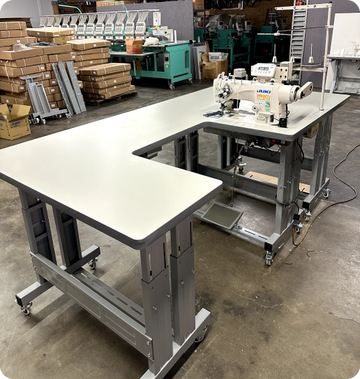
The diagram shows the three tiers side by side. A startup cell is three operators on a shared L-shape. A growing shop runs in a U, with the programmable pattern sewer at the apex. A mass line runs in a straight progressive-bundle pipeline with parallel bottleneck duplication.

Scale economics
| Tier | Output / week | Operators | Capex equipped | Key machines added |
|---|---|---|---|---|
| Startup cell | 20 units | 3 | $35–45K | DDL-9000C · LU-1565N · LBH-1790ANS · LK-1900BN · Serkon DCC70 · grommet press |
| Growing shop | 100 units | 6 | $85–110K | + SR-9950HB (1,300 × 900 mm bed) · AMS-221F · Serkon Fabric Vision |
| Mass production | 500 units | 8–12 | $220–290K | + second SR-9950HB · LU-2210N-7 · duplicated walking-foot · automated spreader · progressive bundle system |
Where quality is won or lost
The 10,000-cycle durability test separates a passing plate carrier from a failing one. Three failure modes surface routinely: PALS webbing bartack failure at the upper rows where arm swing cycles the attach point most frequently; shoulder-strap anchor bartack failure where the plate's weight is loaded; and cummerbund buckle attach failure where quick-release creates shear load on the bartack pattern. Every one traces back to a bartack decision — thread weight, stitch count per bartack, pattern geometry, needle size — not to the body-fabric stitching that most assume is the weak point.
This is why the AMS-221F programmable bartack is not an optional upgrade on a serious plate carrier line. A hand-operated bartack on an LK-1900BN produces the same pattern every time only if the operator holds the piece exactly the same way every time. The AMS-221F removes that variable: the pattern is a stored program, the clamp positions the piece, and the bartack fires identically across 10,000 units.
What this looks like second by second
This is one way a plate carrier line can be built, from our experience working with tactical gear manufacturers. The specific timing — how many seconds each operation really takes, where each automation substitution (SR-9950HB for manual lockstitch; AMS-221F for standard bartack; LU-2210N-7 for LU-1565N on heavy ballistic nylon) actually saves time, and what a benchmark 3-, 6-, or 10-operator cell delivers at each fabric weight — is specific to your material spec, your operator pool, and your target output.
Reach out on our B2B service page and we will expand this build operation by operation, second by second, for the configuration you are planning: Prizzi B2B Service →
The B2B sheet also covers: capex quotes matched to a specific production tier, machine-specific delivery timelines, and the Prizzi technical team's operator training curriculum for a new plate carrier line.

Co-Owner at Prizzi Sewing Machine Co.
Expert in sewing factory workflow optimization